

There’s a weird kind of vertigo that comes with working in SEO right now. You spend years mastering something — backlinks, keyword density, SERP snippets, Core Web Vitals — and then, almost overnight, the ground shifts. Not a gentle nudge. A full tectonic rearrangement.
That’s where we are in 2026. And honestly? It’s equal parts terrifying and fascinating.
When the Search Box Becomes a Conversation
Let’s start with the obvious: people aren’t really “searching” the way they used to. They’re asking. Full sentences, nuanced questions, follow-ups. They want answers, not a list of blue links to sift through at midnight while trying to figure out whether their houseplant is dying or just dramatic.
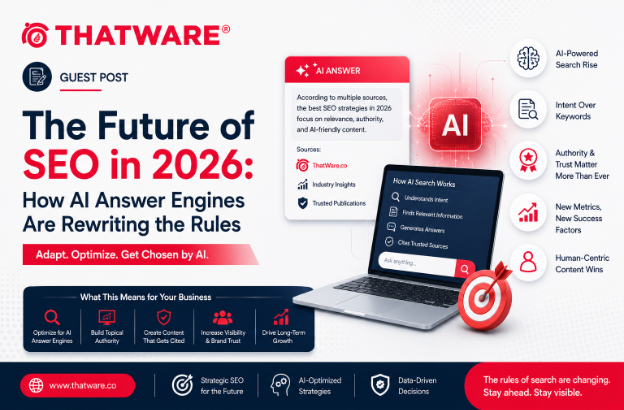
AI answer engines — think Perplexity, Google’s AI Overviews, ChatGPT Search, and a dozen other tools that barely existed three years ago — have fundamentally changed how information gets surfaced. The model now is: ask a question, get a synthesized answer, maybe never visit a website at all.
This is what some are calling “zero-click search” on steroids. And for anyone who built their traffic strategy around organic clicks, the shift feels seismic.
But here’s the thing people aren’t saying loudly enough: it’s not the death of SEO. It’s the death of lazy SEO.
What’s Actually Changing (And What Isn’t)
The mechanics have shifted. But the underlying principle — that authoritative, useful, well-structured content wins — hasn’t gone anywhere. If anything, it matters more.
AI answer engines don’t pull from thin air. They’re trained on, and often actively retrieve from, the web. When Google’s AI Overview summarizes a topic, it’s drawing from sources. When Perplexity cites a response, it links to pages. The question isn’t whether content matters. It’s which content gets selected, synthesized, and surfaced — and why.
This is where the Future of SEO services conversation has gotten genuinely interesting. The brands and agencies paying attention aren’t just trying to rank on page one anymore. They’re optimizing to become the source that AI systems reference. That’s a subtly but profoundly different goal.
Structured data matters more. Entity clarity matters more. Topical depth matters more. Demonstrating genuine expertise — not just surface-level “here are 7 tips” coverage — matters more. The content that AI systems trust tends to be content that reads like it was written by someone who actually knows what they’re talking about. Imagine that.
The Rise of GEO — And Why It’s Not Just a Buzzword
If you haven’t heard the term “Generative Engine Optimization” yet, you will. GEO is the emerging practice of optimizing content not just for traditional search rankings but for inclusion in AI-generated answers. It’s adjacent to SEO but distinct in important ways.
Traditional SEO asks: can Googlebot crawl this page, understand its relevance, and trust its authority?
GEO asks: will an AI model choose to cite this content when answering a user’s question? Will it reproduce a definition from this page? Recommend this brand unprompted?
The tactics differ too. GEO-friendly content tends to be direct and declarative (AI engines love a clean, quotable statement), structurally clear (headers, short paragraphs, FAQs), and deeply authoritative — backed by data, expert quotes, or original research. It anticipates questions and answers them precisely, without filler.
This is a meaningful shift for content strategy. The 2,000-word blog post padded out with repetitive subheadings and vague “key takeaways” sections? That era is genuinely winding down.
Small Businesses Are Getting Hit Hard
Here’s a part of the conversation that doesn’t get enough airtime: the businesses most vulnerable to these shifts aren’t the big players. It’s the small business owner who spent $500/month on an SEO agency for years, built up some decent rankings, and is now watching their traffic drop without a clear explanation.
When AI Overviews answer a question directly, click-through rates for the same query can plummet. Local service businesses, informational blogs, e-commerce sites with product description pages — many of them are quietly hemorrhaging visibility.
This is exactly why SEO evolution consulting has become something people are actively seeking out, not just a niche offering. The businesses that are adapting aren’t just tweaking meta titles. They’re rethinking their entire content infrastructure — what they publish, why, how it’s structured, and how it positions them as a trustworthy source in their category.
The Human Element Isn’t Going Anywhere
There’s a certain irony in all of this. As AI gets better at synthesizing information, the content that stands out is increasingly human — opinionated, specific, experience-driven. First-person accounts. Original research. Perspectives you can’t get from a language model trained on generic web text.
Google has been pushing in this direction for a while with its E-E-A-T framework (Experience, Expertise, Authoritativeness, Trustworthiness). In 2026, that signal matters more than ever. Not because Google says so, but because it’s actually what differentiates content in an environment flooded with AI-generated material.
People — and increasingly, AI systems — can sense when something was written by a person with genuine experience versus assembled from existing text. The texture is different. The specificity is different. An article about managing a software team written by someone who has actually fired and hired engineers reads differently than one generated from a synthesis of LinkedIn posts.
That’s an asset. Real expertise, real voice, real perspective — those aren’t things that can be easily commoditized or replicated.
What Forward-Thinking Teams Are Actually Doing
The SEO teams that are thriving right now aren’t panicking about AI. They’re doing a few things really well.
They’re building topical authority systematically — not just one blog post about a topic, but comprehensive coverage that signals depth of knowledge to both search engines and AI systems. They’re investing in original data, proprietary research, and expert-driven content that has genuine citability. They’re obsessing over structured data and schema markup, making it as easy as possible for AI systems to understand and reference their content accurately.
And they’re watching the metrics that matter now: not just rankings, but brand mentions in AI outputs, citation frequency in AI-generated answers, and direct traffic from audiences who sought them out specifically.
It’s a more mature, more sophisticated version of SEO. Less about tricks, more about genuinely becoming a trusted source in your field.
The Honest Take
Nobody has this fully figured out. Not the big agencies, not the tool vendors, not Google itself, probably. The landscape is changing fast enough that any “definitive guide” published today might need meaningful revision in six months.
What seems durable, though, is this: if you create content that genuinely helps people, demonstrates real expertise, and is structured so machines can understand it, you’re building something that tends to survive algorithm shifts. That was true in 2016. It’s true now.
The rules aren’t so much being rewritten as they are being stress-tested. The shortcuts are disappearing. The foundations are holding.
That’s not a bad place to be, if you’re willing to do the work.